

Straight or Curved Scissors: Choose the Cutting Plane First
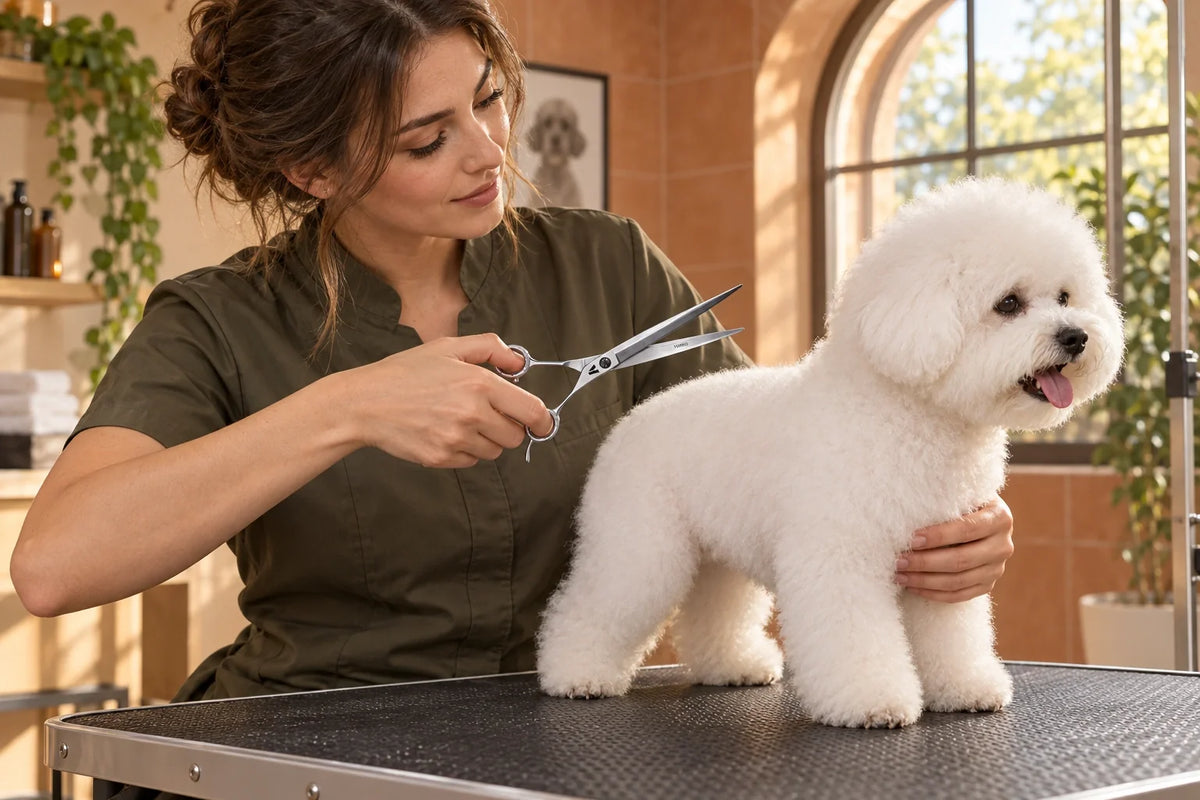
Choosing curved scissors because the dog needs a rounded shape is a reasonable start. It is not the whole decision. A curve only helps if its orientation matches the small part of the outline you are cutting.
Think about the next closure, rather than asking one tool to create the entire shape.
A rounded outline is made from local decisions
Imagine looking directly at the side of a rounded leg furnishing. At any small part of that curve, you can identify a straight line that just touches the intended outline. That local direction is a useful reference for straight scissors. As you move around the shape, the direction changes.
Curved scissors provide a curved cutting edge within their particular cutting plane. They can help you follow a suitable contour with fewer changes of orientation, but the tool's curve is not a mould for every dog's leg, head or shoulder.
This is a geometric way to plan your work. It does not establish that one scissor type is faster or safer in every groom.
Check the plane from a second view
A scissor can look correctly aligned from the side while pointing into the outline when viewed from the front. Before closing, check where the tips and both blades sit in three dimensions. If the dog changes position, the previous alignment no longer tells you enough.
For a junior groomer practising with a supervisor, pause before selected closures and explain which hair lies outside the intended line. If that is difficult to identify, reset the view or section before removing more.
The national occupational standard for styling and finishing asks groomers to choose suitable methods, work to an agreed shape and judge how much hair to remove. The planning exercise here makes those decisions easier to discuss during supervision. Read Lantra's styling and finishing standard.
Match the tool to the next part of the shape
| Task | Useful question |
|---|---|
| Establishing a visible straight reference | Can I see and maintain the line with straight scissors without reaching awkwardly? |
| Following a rounded contour | Does the curved blade match this local contour in the plane I can safely control? |
| Correcting a small uneven patch | Is this genuinely excess length, or has the coat simply fallen differently? |
| Working near a change of surface direction | Do I need to reposition before the next closure instead of extending the previous line? |
Do not cut a curve that the comb created temporarily
Lift and organise the section for visibility, then check how it settles before deciding on the final outline. A section held away from its normal position can give you a different visual line from the same hair at rest.
Make a conservative correction, release the section and look again from your original viewpoint. Repeatedly lifting higher and cutting to the same apparent silhouette can remove more than you intended. Keep the reference consistent.
Position the dog comfortably and use your trained handling method. Reaching around the body to preserve a camera-like view is not worth losing control of the tool or asking the dog to hold an uncomfortable posture.
Build a pair with different jobs
The VUNRO 7.5-inch Precision Straight Scissors and 7.5-inch Precision Curved Scissors offer distinct cutting shapes. Choose between them according to access, the section and the line you can control.
A compact coarse/fine comb supports the preparation and rechecking between cuts. That gives the three tools a coherent purpose: organise the section, establish a line and follow an appropriate contour.
If you are still developing your scissor handling, have a qualified supervisor check your grip, blade control and positioning in person. The photograph illustrates a pause for assessment, not an instruction to hold open scissors near a moving dog.
One useful practice record
After supervised practice, note the area, the tool, the view that helped and the correction you would make next time. “The side looked round; the front view showed the blade pointing inward” teaches you more than “curved scissors worked better”.
Sources and scope
Lantra LANAnC39: Style and finish a dog's coat. Product dimensions and shapes are taken from the linked VUNRO specifications. The cutting-plane exercise is practical geometric reasoning, not a comparative clinical or performance trial.
Keep learning
More from the Blade Blog

Separate a Dry Surface from a Dry Coat
Read the guide →
Check the Outline in Motion Before Making Another Cut
Read the guide →


